
Science-backed parenting guidance

One small, steady thing to try with your kid today.

Daily Parent gives you one short, research-backed tip each morning — tuned to your child’s age and the moments you’re working through. No streaks, no shame, no scrolling.

Free to try. Android coming this fall — join the waitlist.

Hero illustration · replace
“Warm storybook scene — a parent and child playing on the living-room floor together, soft cream light, plants, scattered toys.”
Same illustrator style as the in-app art. Roughly 4:5 portrait. Generate and drop in as assets/hero-family.png.
Grounded in the work of
  • Adele Faber & Elaine Mazlish
  • Daniel J. Siegel & Tina Payne Bryson
  • Vicki Hoefle
  • Ross W. Greene
  • Becky Kennedy
How it works

Three minutes a day. One steadier moment.

No course to finish, no streak to keep alive. Just one short, age-tuned thing to try with your kid each morning.

1

Tell us about your family.

Pick a topic you're working through and the ages of your kids. We'll tune the next two weeks of tips around that.

2

Get one small thing each morning.

A short, research-backed tip, talking point, or exercise — written for the moment, not for a textbook. Five-minute read, tops.

3

Note what actually worked.

A quick tap in your journal. Over a few weeks, you build a real playbook of what helps your kid — and what doesn't.

Today

The right one small thing, every morning.

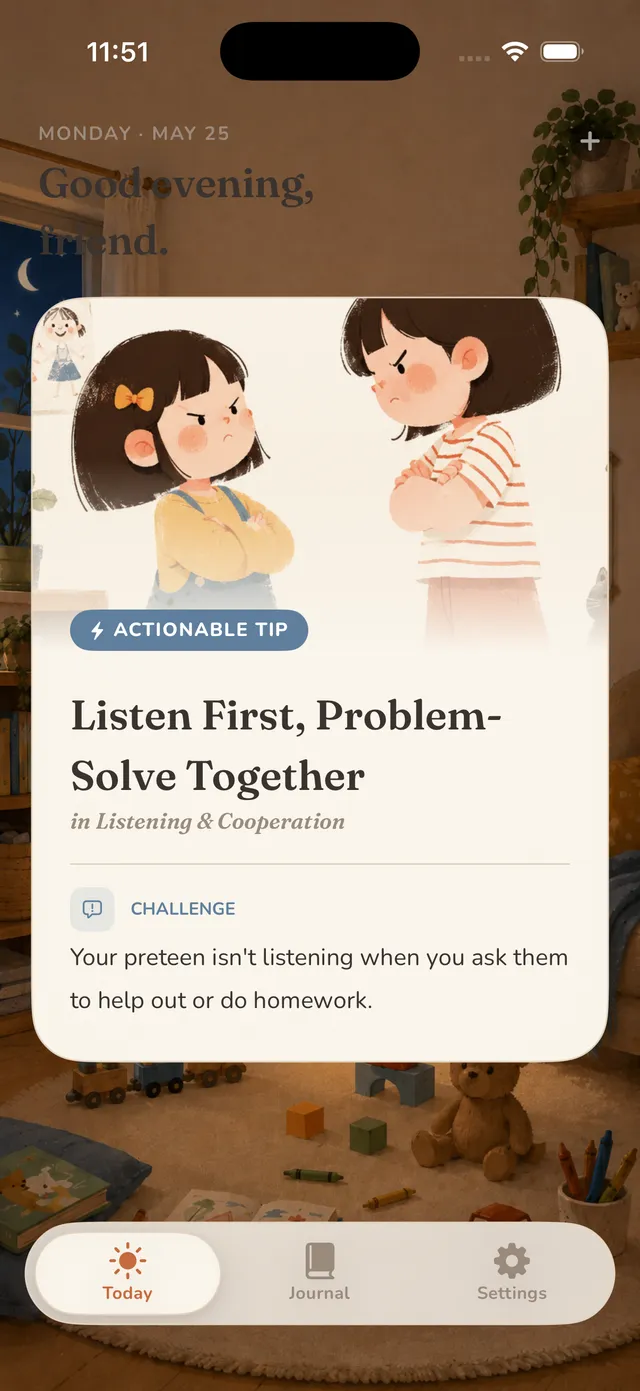
Open the app, see today’s tip. That’s it. No feed to scroll, no dashboard to manage. Each tip is built around one challenge — a meltdown at the front door, a refusal to come to dinner, a bedtime that’s slipping later — and gives you something concrete to try.

  • Three formats: actionable tip, what-to-say, conversation starter.
  • Tuned to your child’s age — toddler, kid, preteen, teen.
  • Short. The whole thing fits in a coffee.
Today screen — Listen first, problem-solve together
Tip detail

Every tip earns its place.

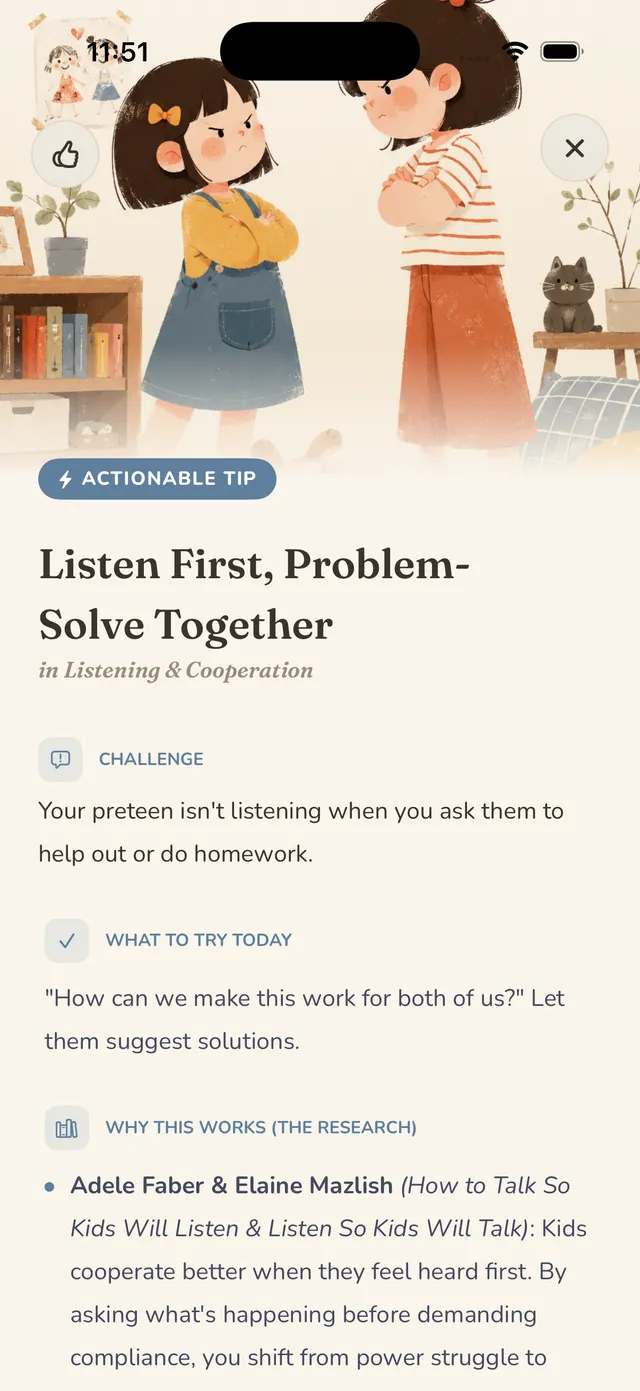
Each one is structured the same way: the challenge, what to try today, why it works (with the actual researchers cited), and the common mistakes we all make. So you’re not just doing — you understand the why, which is what makes it stick.

  • Cites real authors and research, not vibes.
  • Names the common mistakes so you can sidestep them.
  • One tap to save it to your journal for later.
Tip detail — Listen first, problem-solve together
Journal

The tips you actually used live here.

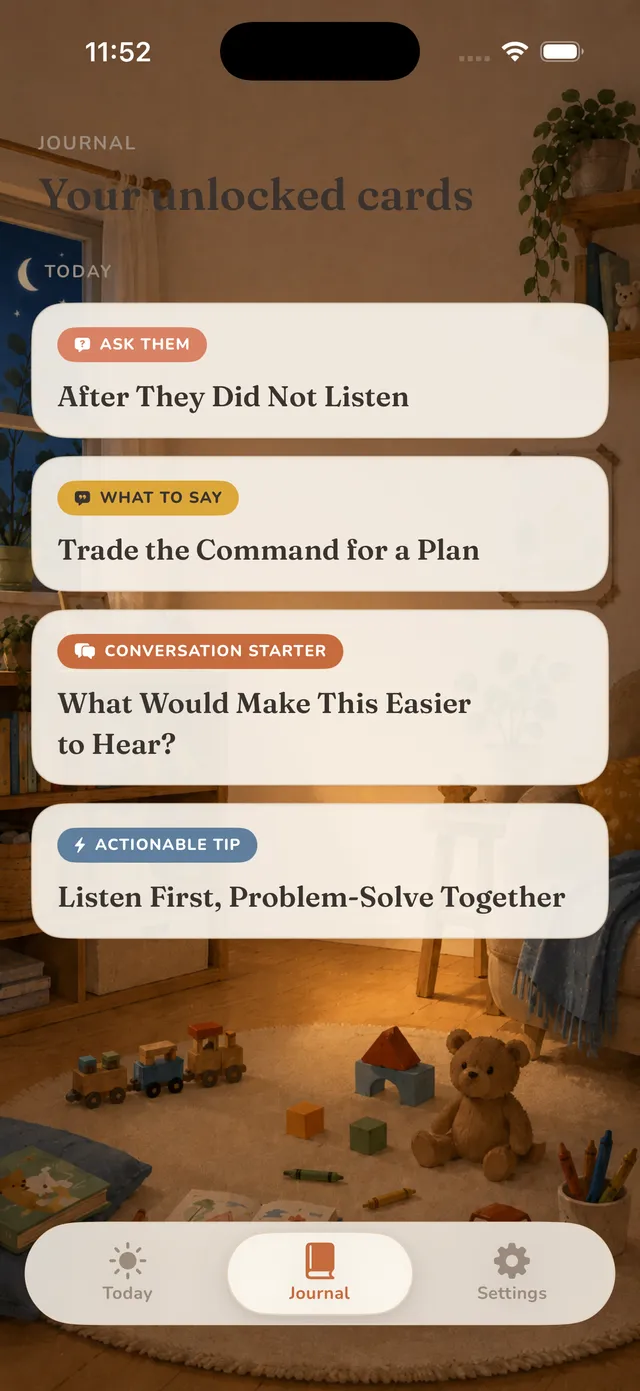
Tap the heart on anything that landed. Over a few weeks, you’ll have your own quiet library — the language, the openers, the moves that work for your kid. Pull it up at 7 p.m. when you’ve got nothing left.

  • Filter by category, age, or what worked.
  • Add private notes about what actually happened.
  • Share a card to a partner so you’re parenting on the same page.
Journal — your unlocked cards
A real tip

This is what shows up in your morning.

Today’s tip in Listening & Cooperation, exactly as a parent of a preteen would see it.

Two siblings, arms crossed, mid-argument in their bedroom
Actionable tip

Listen first, problem-solve together.

in Listening & Cooperation

Challenge

Your preteen isn’t listening when you ask them to help out or do homework.

What to try today

“How can we make this work for both of us?” Let them suggest the solution. The shift from command to collaboration moves the brain out of resistance.

Why this works

Adele Faber & Elaine Mazlish (How to Talk So Kids Will Listen) found kids cooperate when they feel heard first. Siegel & Bryson add: during conflict, a preteen’s logical brain shuts down — validating their perspective brings it back online.

5 min read · tuned for ages 8–12Save to journal · Share with partner
What we cover

The moments that are hardest.

Pick the area you're working on. We'll shape your daily tips around it — and you can swap focus whenever the season changes.

The library

Deeper reading, for the harder weeks.

Long-form guides that go beyond a daily tip — the full picture on the things parents wrestle with most. Free to read, no app needed.

All guides
The research

Every tip cites its source.

We don't make it up. Each daily tip and every guide is built on the work of researchers and clinicians who have spent careers understanding how children and parents actually relate.

Kids cooperate better when they feel heard first — before any instruction, before any consequence.
Drawn from Faber & Mazlish · How to Talk So Kids Will Listen
During conflict, the logical brain shuts down. Listening and validation bring it back online — that's how cooperation gets possible.
Drawn from Siegel & Bryson · No-Drama Discipline
Children behave well when they can. The work is figuring out what's getting in the way — not adding more pressure.
Drawn from Ross W. Greene · The Explosive Child
From other parents

Steadier mornings. Less guessing.

A few notes from families who have been using Daily Parent in beta.

The daily tips made hard mornings feel less chaotic. I had something simple to try instead of guessing.
Parent of a 6-year-old
I liked that it gave me language I could actually use with my teen. Not generic — words that fit her.
Parent of a teen
It helped me pause, understand what was happening, and respond with more confidence.
Parent of two
Founder portrait — warm illustration or candid photo
A note from the founder
I built Daily Parent because the books are sitting on my shelf unread. I needed one small thing in the morning — something I could actually try by lunch. Not a course. Not a feed. Just the next steady step.
Chris· Founder, parent of two
Questions

Good ones to ask before you start.

Is this free?
There's a free tier — a daily tip every morning, no time limit. A small subscription unlocks the full library, partner sharing, and the long-form guides. We don't do free trials that require a credit card.
Is it really tuned to my child's age?
Yes. We split by Baby (0–23 mo), Toddler (2–4), Kid (5–7), Pre-Teen (8–12), and Teen (13–18). The same topic — say, "not listening" — gets a different tip and a different script for a 4-year-old vs a 13-year-old, because the developmental story is different.
Where does the advice come from?
Every tip cites the researcher, clinician, or book it draws from. Our most-cited voices: Adele Faber & Elaine Mazlish, Daniel Siegel & Tina Payne Bryson, Vicki Hoefle, Ross W. Greene, and Becky Kennedy. We don't publish anything that isn't grounded in published, peer-reviewed, or clinically established work.
How is this different from reading a parenting book?
The book is the foundation. Daily Parent is the next morning. We translate the research into one specific thing to try with the kid in front of you today — and then we hand you the next one tomorrow, so the practice actually happens.
What if today's tip doesn't apply to me?
Skip it. Nothing to dismiss, no streak to break. Pull up the library, search the moment you’re actually in, save what helps. The morning tip is a starting point, not a quota.
Is there an Android version?
Android lands this fall. Join the waitlist and we’ll write you the day it ships.
Will my data be used to train anything?
No. Your journal is private — we don't read it, sell it, or train models on it. Account data is held only for what's needed to run the product. The full policy is in our privacy page.
Start with today.

Tomorrow morning, one small thing.

Download Daily Parent and see what shows up — for the kid you have, in the season you're in.